
Article —
Kandev, a workbench for your coding agents
Kandev is an open-source workbench where you plan a task with an agent, approve the plan, and review what comes back. Here is what it is, what it isn't, and who will like it.
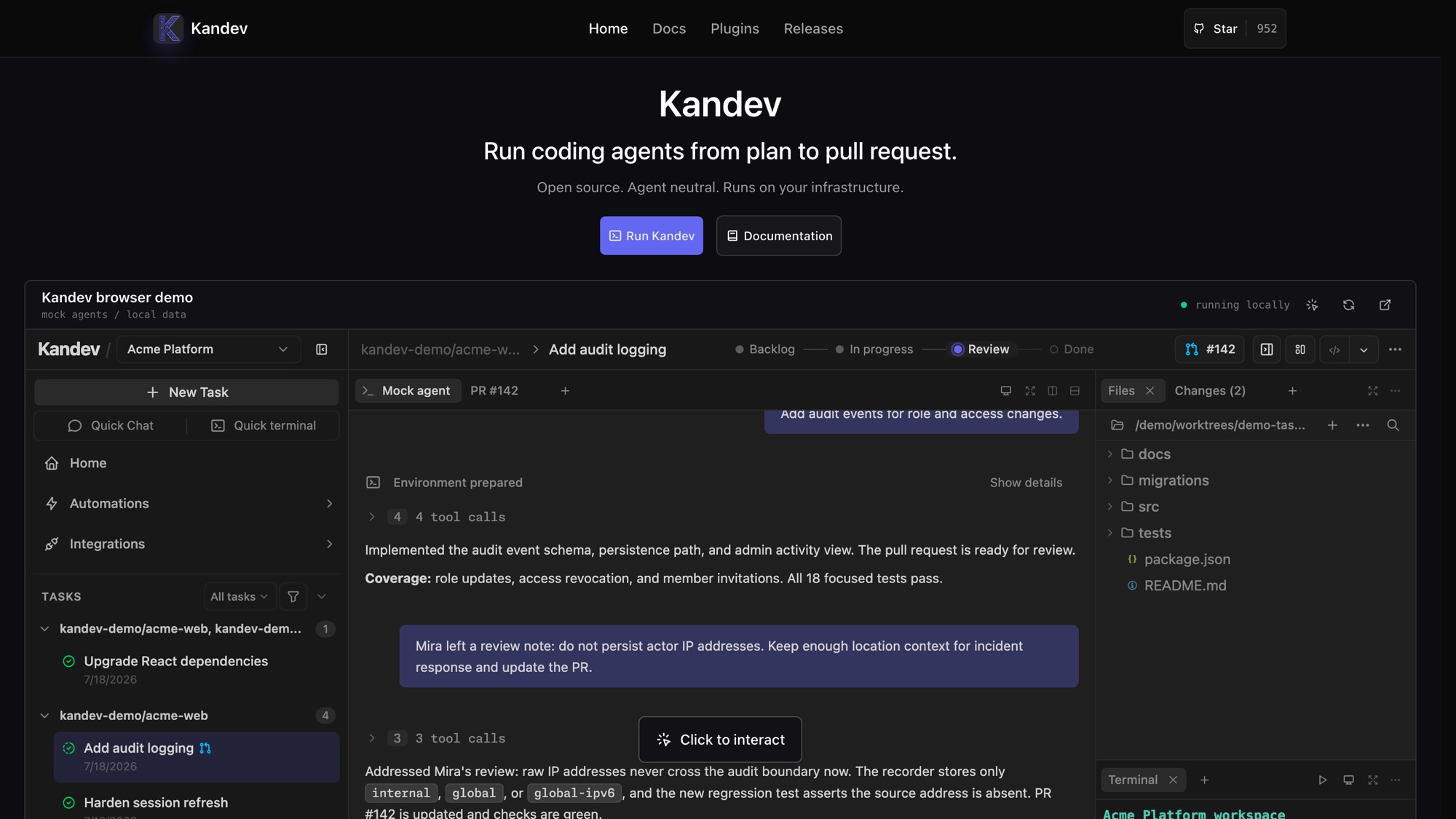
If you use coding agents every day, you know the drill: three terminals, a few branches, and a growing doubt about which agent is doing what. Kandev is an attempt to give that mess a home. They call it “the open workbench for coding agents”, and that is a fair description.
What it is
A place to run the agents you already have. You create a task and plan it with an agent. You comment on the plan, fix what looks off and approve it. Only then does the agent start coding, in its own isolated workspace: a git worktree, a Docker container or an SSH box. What comes back is something you can review, and review is where it ends.
It doesn’t care much which agent you like. Claude Code, Codex, Copilot, Gemini CLI and OpenCode all work. It can pull in tickets from GitHub, GitLab, Jira and Linear, and events from Sentry and Slack. It is open source and says it has no telemetry.
What it is not
- Not an agent or a model. Bring your own.
- Not a way to take yourself out of the loop. The plan-first flow exists so that you stay in it.
- Not a hosted service. It runs on your machine or your infrastructure.
Why I like the idea
The plan step. Most agent failures I see are not bad code, they are a good solution to the wrong problem. Catching that in a plan costs a minute; catching it in a pull request costs an afternoon.
Who it’s for
Developers and small teams who already work with several agents and want order instead of tab roulette. If you run one agent on one task at a time, plain terminal and git are probably enough.